
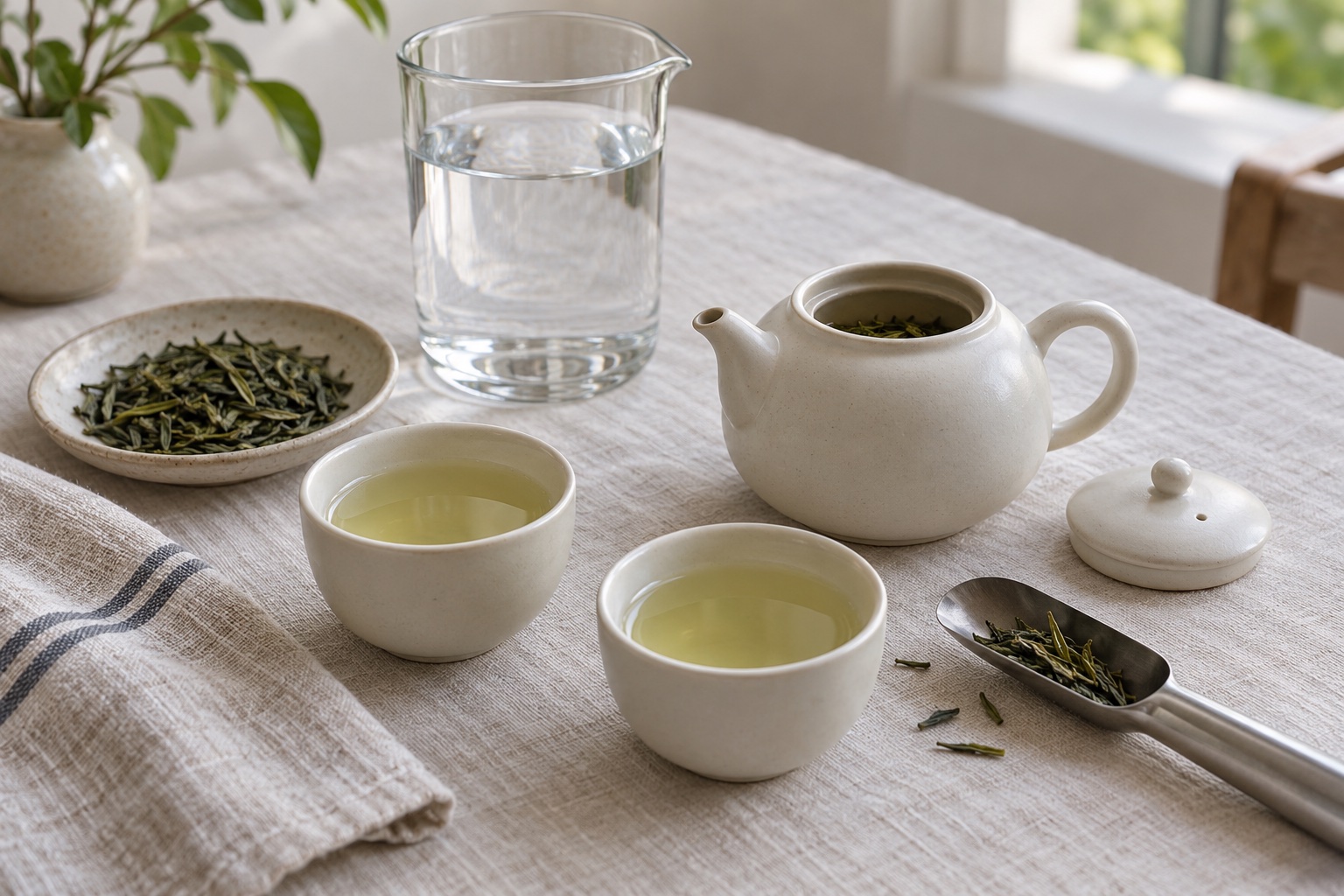
Measure the amount of water your teapot can handle comfortably, with its lid and infuser fitted as intended. A brimful volume is not automatically a useful brewing volume. You need room to move the pot, fit the lid and pour without liquid escaping where it should not.
Read the product's stated capacity and instructions first. Some makers explicitly call a figure practical capacity. Hario's cold brew tea carafe, for example, lists a practical capacity of 1,000 mL. That label describes that product; it does not tell you the working volume of a different teapot.
Measure with room-temperature water
Put the clean, empty vessel on a stable surface. Add measured water gradually to the maker's fill line or a conservative level below the lid and spout openings, following the vessel's instructions. Use room-temperature water for this measurement so an accidental spill does not involve boiling water.
Fit the lid and infuser, if any, and test the pour over a sink or tray. Check that the lid remains secure when held as directed and that the spout drains predictably. Do not fill beyond a marked maximum to achieve the nominal number printed on a box.
Record the added water volume as the water-only working capacity. If your measuring jug has coarse marks, choose a sensible rounding level. There is little benefit in writing 287.4 mL when the jug only has clear marks every 50 mL.
Repeat with the intended leaf dose
Dry leaves and a brewing basket occupy space, and leaves change as they wet. Repeat your normal brewing setup at a safe volume consistent with the product instructions. Note the water added and the amount poured out after draining normally. Do not squeeze or force the leaves merely to make the output equal the input.
A difference between brewing water and served tea is expected because water remains in the leaves and vessel. That difference depends on the leaf, dose, equipment and draining method. Use your observation as a planning value for that setup, not a fixed absorption constant for all tea.
Plan servings from poured volume
If a trial pours 240 mL and you want two equal servings, each serving is 120 mL. A set of cups labeled 150 mL may still be comfortable at that fill. Measure the cups' practical serving level too, especially if the cup shapes differ.
For a group, decide whether to brew another round or use a larger vessel. Filling a small teapot beyond its working level introduces a handling problem. A second batch can also change timing, so pour into a suitable serving pitcher if you want to distribute one combined brew evenly.
Keep a small vessel card
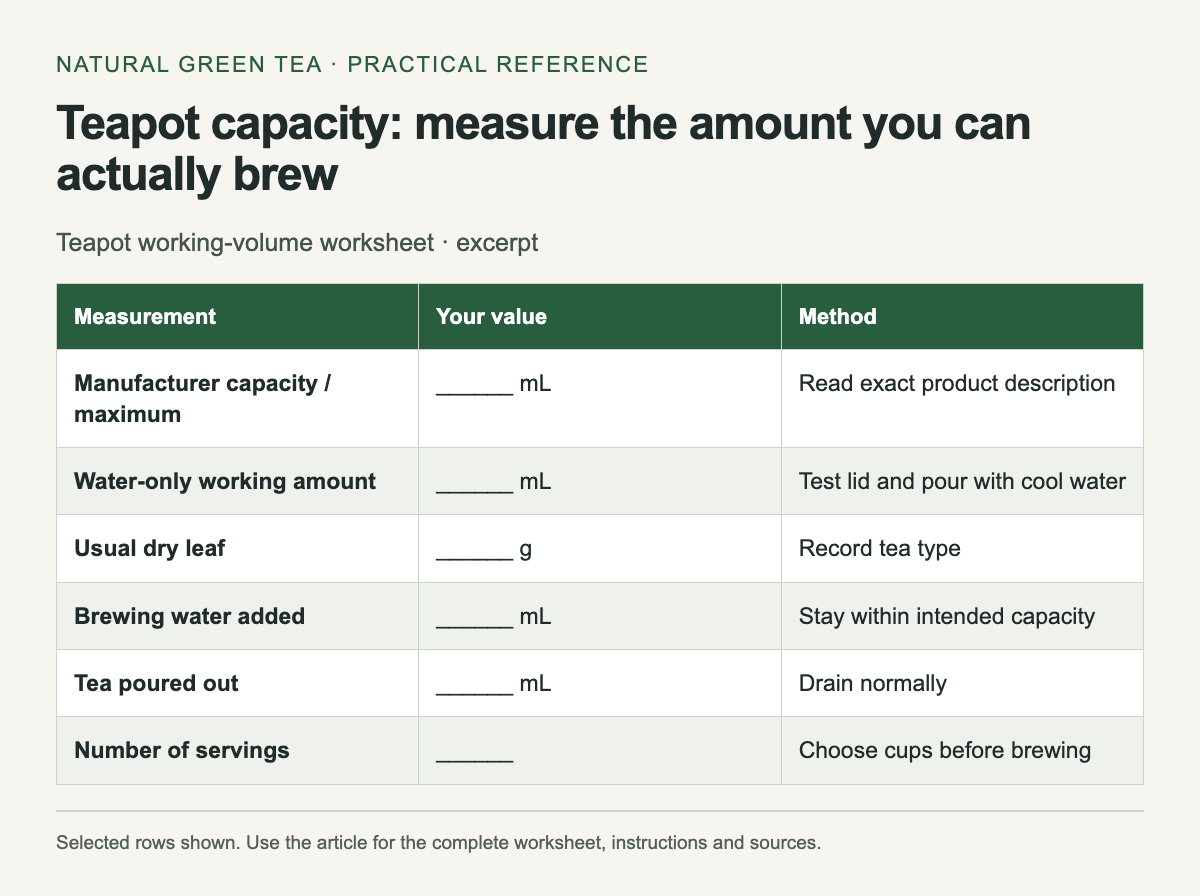
Write the pot name, water-only working volume, usual leaf dose, brewing water and poured volume on one card. Add the number and size of servings. This makes it easier to scale a recipe when moving between a mug infuser and a small teapot.
Recheck if you change the basket or use a very different leaf style. A compact rolled leaf and a bulky blend can occupy the infuser differently. The site's infuser guide addresses room for leaves; use the measurement here to choose a batch size that the vessel can handle without crowding or overfilling.
If the basket occupies too much of the pot, compare infuser baskets and tea balls before changing the leaf dose to make the setup fit.
| Measurement | Your value | Method |
|---|---|---|
| Manufacturer capacity / maximum | ______ mL | Read exact product description |
| Water-only working amount | ______ mL | Test lid and pour with cool water |
| Usual dry leaf | ______ g | Record tea type |
| Brewing water added | ______ mL | Stay within intended capacity |
| Tea poured out | ______ mL | Drain normally |
| Number of servings | ______ | Choose cups before brewing |
| Volume per serving | Output ÷ servings | Round to a usable measure |
Related tea guides
- Tea Infuser Basket vs Tea Ball: Which Works for Green Tea?
- How to Use a Gaiwan for Green Tea: A Beginner’s Guide
Sources

No comments:
Post a Comment