
Calculate tea cost from the amount of dry leaf you use and the servings you actually drink. A package price divided by a seller's suggested cup count may not describe your routine. A large mug, a concentrated small pot and several shared infusions use the package differently.
Start with cost per gram: package cost ÷ net tea weight. Multiply that by your dry-leaf dose to get the cost of one brewing session. Divide by the number of consumed servings from that dose if you want cost per serving. Decide what you mean by a serving and keep it consistent between comparisons.
A transparent example
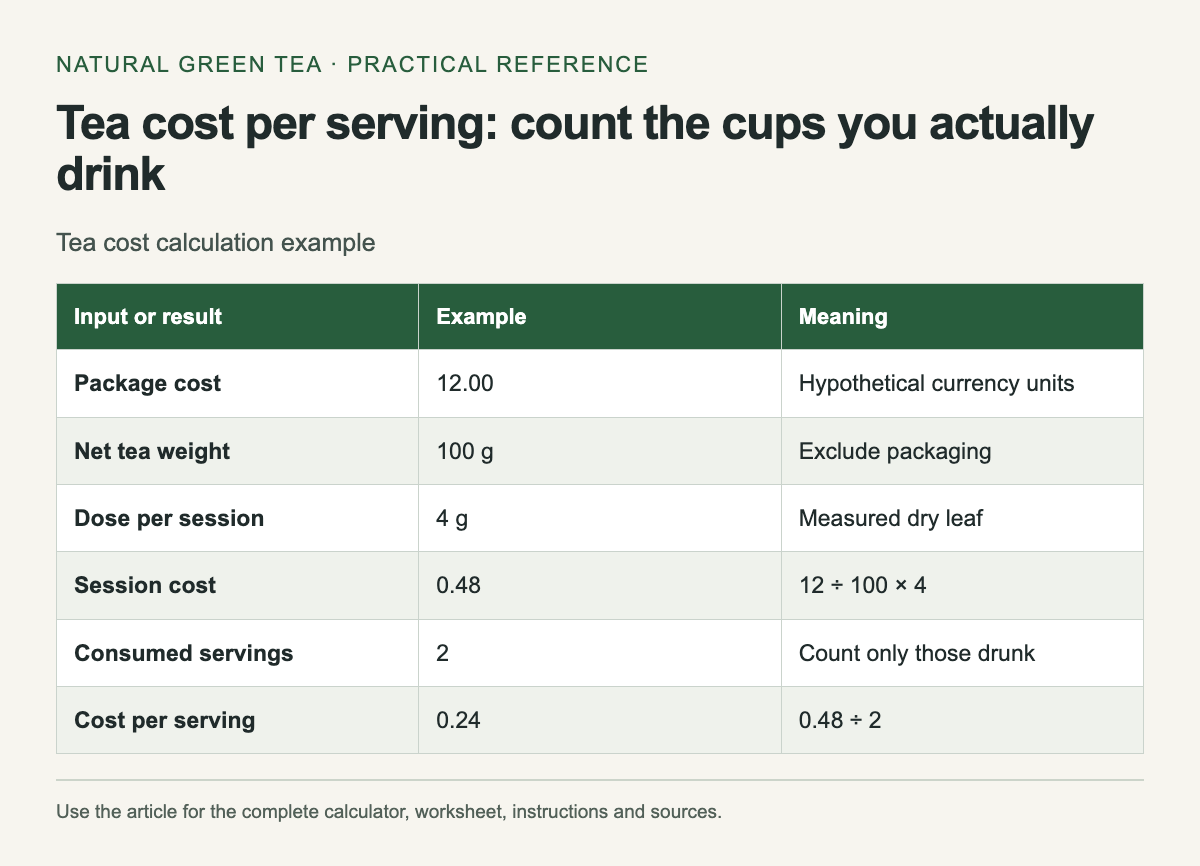
Suppose a hypothetical 100 g bag costs 12 currency units. The leaf costs 0.12 per gram. A 4 g session costs 0.48. If that session produces two servings that you drink, each serving costs 0.24. If you drink only the first, the cost per consumed serving is 0.48.
These are invented prices for demonstrating the formula. They are not current offers or claims that a particular tea will yield two enjoyable brews. Enter prices from the products you are comparing and use your own recorded leaf dose.
A session shared by two people can also produce two servings from one brew. That differs from two successive infusions, but the cost calculation is the same if both servings are consumed. The calculator counts servings, so enter the final number of cups actually shared or drunk, not an assumed resteep count.
Include delivery consistently
For a one-product order, you can add delivery to the package cost. In a mixed order, choose a reasonable allocation method, such as allocating by product value or weight, and use it for both options. Record the method. Otherwise an attractive comparison may simply put all shipping on one tea and none on another.
If a purchase includes a reusable tin or accessory, decide whether you are comparing the full first purchase or the later refill. Both questions can be useful. Label the result as first-purchase cost or refill cost so the cheaper-looking number does not hide what you must pay today.
Resteeping needs an honest denominator
Some teas suit several infusions in a session, but a theoretical maximum can distort the calculation. Ippodo's large-batch preparation explicitly reuses leaves for later brews. That recipe does not establish how many cups you personally will enjoy from every tea.
Try your normal routine for a few sessions and record what you finish. If the last brew consistently sits untouched, do not count it as a saving. Keep cup size similar when comparing teas, or calculate cost per 100 mL consumed alongside cost per serving.
Use the result for a purchase decision
Compare taste and convenience with the cost, especially if you are deciding between a large unfamiliar bag and a small familiar one. A low cost per gram has little value when half the bag remains unused. The order-size planner linked through the blog's storage guidance can help you estimate consumption before buying more.
Save the package weight and price with your brew notes. When the product or dose changes, recalculate. Avoid reporting extra decimal places as meaningful precision; round the final serving cost to a useful currency amount and retain the underlying inputs for the next comparison.
The tea bags versus loose leaf comparison adds convenience and preparation differences to the cost calculation.
| Input or result | Example | Meaning |
|---|---|---|
| Package cost | 12.00 | Hypothetical currency units |
| Net tea weight | 100 g | Exclude packaging |
| Dose per session | 4 g | Measured dry leaf |
| Session cost | 0.48 | 12 ÷ 100 × 4 |
| Consumed servings | 2 | Count only those drunk |
| Cost per serving | 0.24 | 0.48 ÷ 2 |
Calculate your result
Values stay in this page. The worked example also works without JavaScript.
Related tea guides
- Green Tea Bags vs Loose Leaf: Taste, Cost and Convenience
- How to Store Green Tea After Opening: Keep Loose Leaves Fresh

No comments:
Post a Comment